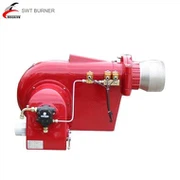

Classification of Low-NOx Burners
Aug 21, 2025
What are the top 10 low-NOx burners in the world? What are the categories of low-NOx burners?
Boiler burners are essential components of industrial furnaces, ensuring stable fuel ignition and complete combustion. Based on their NOx reduction technology, low-NOx burners are broadly classified into the following categories:
1. Staged Burners: Designed based on the principle of staged combustion, these burners mix fuel and air in stages. Because combustion violates the theoretical equivalence ratio, they can reduce NOx generation.
2. Self-Recirculation Burners: One type uses the pressure of the combustion air to draw a portion of the combustion flue gas back into the burner, where it mixes with air for combustion. This flue gas recirculation increases the heat capacity of the combustion flue gas, lowering the combustion temperature and reducing NOx.
Another type of self-recirculation burner recirculates a portion of the flue gas directly into the burner and adds it to the combustion process. This type of burner has the dual purpose of suppressing NOx and saving energy.
3. Rich-Lean Burners
The principle of a Industrial boiler burner is to burn a portion of the fuel as a rich burner and another portion as a lean burner, while maintaining the same overall air volume. Because both components burn at a counter-stoichiometric ratio, NOx emissions are very low. This type of combustion is also called counter-stoichiometric or non-stoichiometric combustion.
4. Cut-Flame Burner
The principle of a flame burner is to split a single flame into several smaller flames. Because the smaller flames have a larger heat dissipation area and lower flame temperatures, "thermal reaction NO" is reduced. Furthermore, the smaller flames shorten the residence time of gases like oxygen and nitrogen in the flame, significantly suppressing both "thermal reaction NO" and "fuel NO."
5. Mixing-Promoting Burner
The residence time of flue gas in the high-temperature zone is one of the main factors affecting NOx generation. Improving the mixing of combustion and air can reduce the thickness of the flame surface. Under constant combustion load, the residence time of flue gas in the flame surface, i.e., the high-temperature zone, is shortened, thereby reducing NOx generation. Mixing-promoting burners are designed based on this principle.
6. Low NOx Precombustion Chamber Burner: The precombustion chamber is a high-efficiency, low-NOx staged combustion technology developed and researched in my country over the past 10 years. The precombustion chamber generally consists of primary air (or secondary air) and a fuel injection system. The fuel and primary air are rapidly mixed to form a fuel-rich mixture in the primary combustion zone of the precombustion chamber. Due to the lack of oxygen, only a portion of the fuel is burned. The fuel evaporates in the oxygen-depleted and lower flame temperature primary flame zone, thereby reducing NOx generation.
For more Low NOx Burners and Combustion Systems details please contact SWT Burner Manufacturing!